
Understanding CFD Trading
Contract for Difference (CFD) trading is an intriguing financial instrument offering traders the ability to speculate on the price movements of a wide range of assets without the necessity of owning the underlying assets. This flexibility extends to trading on margin, a process that amplifies both potential profits and losses. As such, it becomes imperative to develop a solid comprehension of the myriad factors that influence CFD prices before setting up initial entry rules. Among these factors are market trends, pivotal economic indicators, and various global events that have the potential to alter asset values significantly.
Establishing Simple Entry Rules
Crafting effective entry rules serves as the cornerstone of successful CFD trading. These rules are fundamentally designed to minimize risk while simultaneously maximizing potential gains. To achieve this delicate balance, traders need to consider a variety of fundamental components in their strategy development.
Market Analysis
Prior to initiating any trade, conducting an exhaustive market analysis is paramount. This encompasses both fundamental analysis and technical analysis. Fundamental analysis involves a detailed examination of economic indicators and geopolitical events that could sway asset prices. On the other hand, technical analysis helps traders to interpret market trends and discern price patterns through commonly utilized indicators such as moving averages, the Relative Strength Index (RSI), and Bollinger Bands. These tools assist traders in gauging market conditions and determining optimal times for entry.
Define Trade Entry Criteria
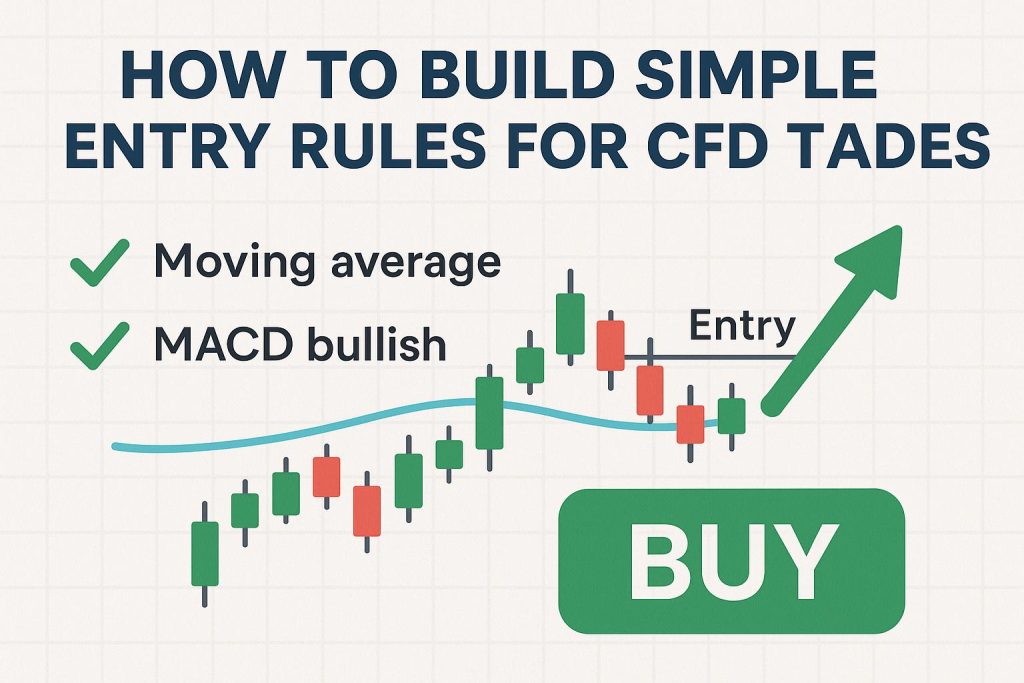
Clearly establishing trade entry criteria is imperative. A recommended approach is to amalgamate various technical indicators that collectively indicate a high probability of profitable price movements. For instance, traders might consider entering a trade when the price breaches a clearly defined support or resistance level, or when an intersection of moving averages signals a trend reversal.
Risk-to-Reward Ratio
Setting a comprehensive risk-to-reward ratio is crucial in CFD trading. This involves predefining a profit target that exceeds the amount at stake. Typically, traders aim for a ratio of 1:2 or 1:3, suggesting that the potential gain should be at least twice or thrice the potential loss. This strategic planning ensures that even if only a fraction of trades are successful, the overall strategy could still yield profitability.
Stop-Loss Orders
In order to safeguard against substantial losses, traders should invariably set stop-loss orders. These orders are strategically placed to automatically terminate a trade when the price reaches a predetermined level in the event of an adverse market movement. The strategic placement of stop-loss orders should consider the asset’s volatility; a tight stop-loss could mitigate excessive losses but might also close trades prematurely during volatile conditions.
Maintaining Discipline and Flexibility
Although entry rules constitute a vital part of a trading strategy, maintaining discipline in adhering to these rules is just as critical. Emotional decision-making can easily derail the most meticulously crafted strategies. Moreover, the dynamic nature of the market necessitates a certain degree of flexibility, enabling traders to adapt their rules to ever-evolving market conditions. This involves regular review and adjustment of strategies, grounded in performance data and shifting market dynamics, to ensure optimal trading success.
Seeking more in-depth knowledge and strategies of CFD trading can be advantageous. Traders might consider consulting seasoned professionals or pursuing structured learning through reputable platforms offering online financial courses or participating in seminars. Ultimately, the key to successful trading lies in the harmonious amalgamation of robust knowledge, incisive analysis, and disciplined execution.
Understanding Margin in CFD Trading
Margin trading is a distinctive feature in CFDs, allowing traders to use borrowed funds to increase their position size. This means that with a relatively small amount of capital, a trader can control a larger position, amplifying potential gains. However, this also escalates the potential for losses. Margin requirements can vary depending on the broker and the asset being traded, so it is essential for traders to thoroughly understand these terms before engaging in CFDs.
Leverage in CFD Trading
The concept of leverage is akin to trading on margin, offering traders the ability to control substantial positions with a minimal actual investment. For instance, a leverage of 10:1 allows a trader to control a $10,000 position with only $1,000. While this can significantly enhance profits, it equally heightens the risk of considerable losses, emphasizing the need for well-defined risk management strategies.
Managing Emotional Control
One of the most challenging aspects of trading, including CFD trading, is managing emotional responses. The allure of high returns can sometimes lead traders to forsake their plan and take impulsive actions. Emotional control is vital for maintaining discipline in sticking to predetermined trading rules. Traders are encouraged to develop a trading plan and rigorously follow it, only making adjustments when it aligns with their long-term strategy. Using protective measures like stop-loss and taking a break during periods of intense market volatility can be beneficial in curbing emotional trading.
Adapting to Changing Markets
The financial markets are ever-changing and influenced by numerous factors ranging from economic news to geopolitical developments. Traders should be prepared to adapt their strategies in response to such changes. This flexibility involves ongoing learning and adaptation based on past performance data, thereby optimally positioning oneself to capitalize on evolving market dynamics.
In summary, CFD trading provides a versatile platform for traders to speculate on asset prices without actual ownership. Effective trading relies heavily on establishing clear entry rules, understanding margin and leverage, managing risk through ratio and stop-loss techniques, and maintaining a disciplined yet adaptable approach to market conditions. As traders delve into CFDs, an emphasis on continuous education and adherence to sound trading principles forms the bedrock for sustained success.
This article was last updated on: September 4, 2026