
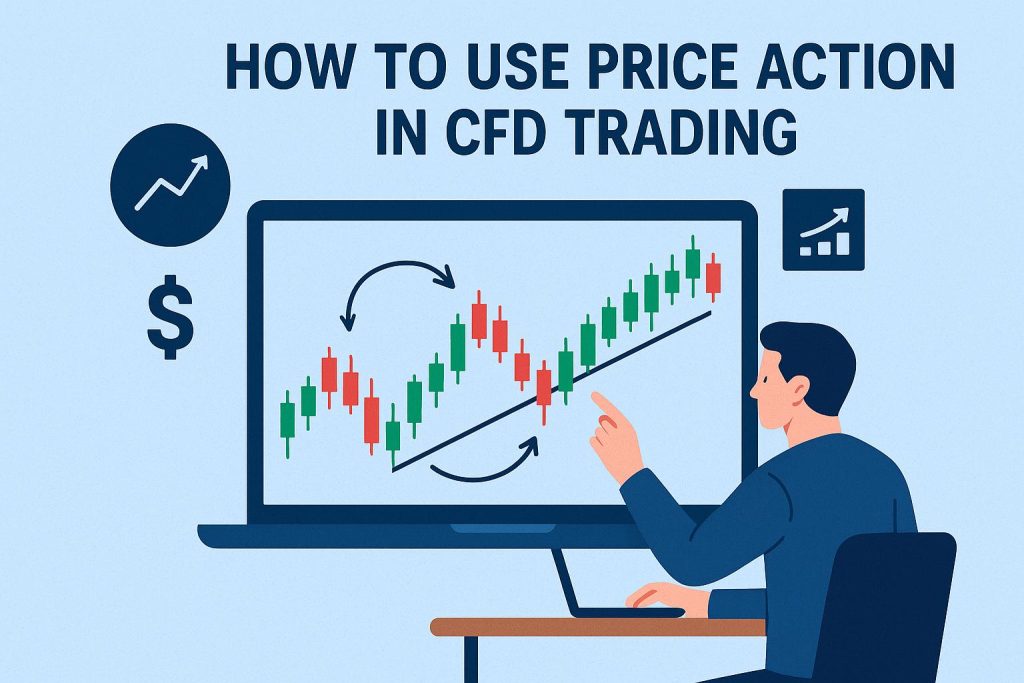
Understanding Price Action in CFD Trading
Price action is a cornerstone of technical trading, referring to the movement of a security’s price over time. Traders who engage in Contracts for Difference (CFD) trading often prioritize understanding price action, as it gives them insights into the market trends based on actual price movements instead of relying heavily on technical indicators. By analyzing price action, CFD traders can interpret raw market data to make well-informed trading decisions.
Key Concepts of Price Action
For CFD traders, price action analysis serves as a powerful tool to anticipate market trends, reversals, and key levels. This approach to analysis offers a unique perspective by focusing on real-time data, as opposed to historical indicators, thereby providing a fresher view of the market’s current behavior.
Trend Identification
One of the primary objectives of price action analysis is to determine the prevailing market trend. Understanding whether the market is trending upward, downward, or moving sideways is critical for successful trading. Traders make use of visual tools like trend lines and channels which are constructed by linking notable price points on a chart. These graphical tools are essential for traders to map out potential entry and exit strategies based on the trend’s direction.
Support and Resistance Levels
Support and resistance levels serve as psychological markers on a price chart. These levels are indicative of points where the price movement is likely to halt or reverse its direction. Support levels are areas where downward trends are expected to pause due to a surge in buying pressure, creating a floor for price action. Conversely, resistance levels indicate areas where upward trends might pause, as selling pressure causes the price to retreat. By recognizing these crucial levels, traders can better predict price behavior.
Implementing Price Action in CFD Trading
The application of price action in CFD trading revolves around identifying distinctive price patterns that hint at forthcoming market movements. These patterns can be powerful indicators of future market shifts, offering crucial information that can further inform trading strategies.
Candlestick Patterns
Candlestick charts and their patterns are among the most effective tools for traders employing price action strategies. Each candlestick’s structure reveals much about market sentiment, and when patterns form, they offer valuable insights into future price directions. Recognizing common candlestick patterns such as the engulfing pattern, hammer, and shooting star can significantly enhance a trader’s ability to forecast market changes.
Engulfing Pattern
The engulfing pattern is a two-candle formation where one candle fully encompasses the body of the preceding candle. This pattern is vital as it can denote a strong potential reversal, signaling traders to prepare for a possible trend change. The pattern becomes particularly telling when it appears after a defined uptrend or downtrend.
Hammer and Shooting Star
Single candlestick formations like the hammer and shooting star also play significant roles in price action analysis. The hammer is seen as a potent indicator of a bullish reversal in a declining market and is characterized by a small body with a long wick below. On the other hand, the shooting star suggests a bearish reversal in an advancing market, displaying a small body with a long upper wick.
Chart Interpretation
Beyond merely recognizing patterns and formations, a comprehensive analysis requires interpreting the space between bars, changes in trading range, and the velocity of price movements. These subtle variations provide traders with deeper insights into the market dynamics at play, enabling them to anticipate potential changes in market behavior more accurately.
Conclusion
Price action is an indispensable analytic tool in the realm of CFD trading. It provides traders with insights that extend beyond conventional indicators, by allowing them to scrutinize price movements and identify patterns for better decision-making. Traders can sharpen their strategies and make more strategic trading choices through a nuanced understanding of price action. For additional resources and in-depth information on trading strategies, visiting dedicated trading websites can be immensely helpful.
This article was last updated on: May 29, 2026