
Understanding Range Bound Markets
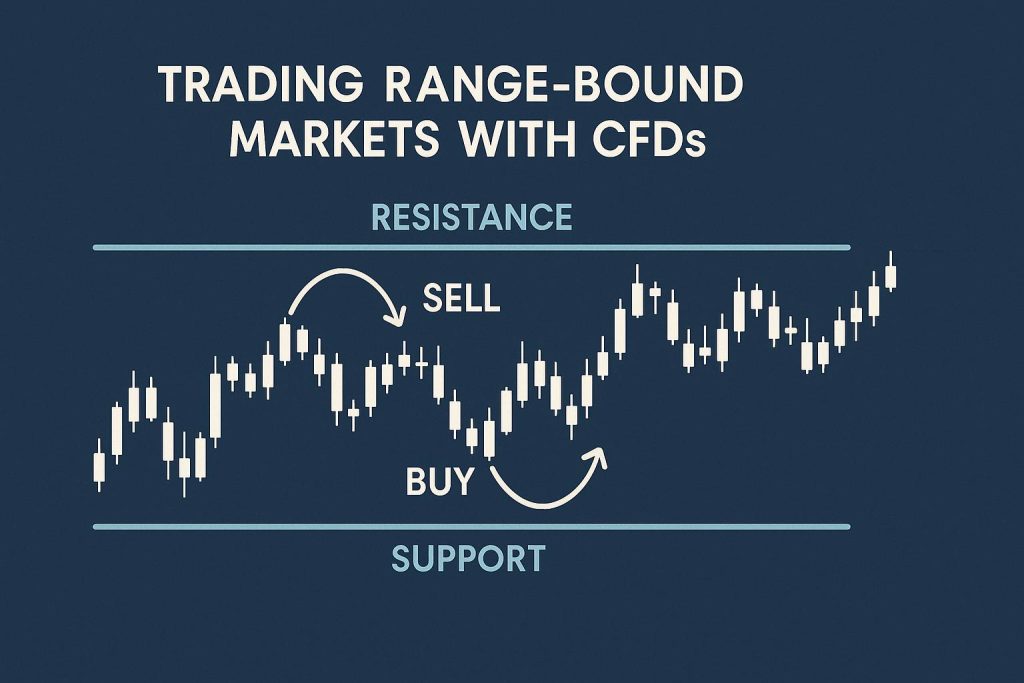
Range bound markets occur when the price of a financial instrument trades within a specific range for a sustained period, rather than exhibiting a clear upward or downward trend. The essence of a range bound market lies in its cyclical nature, where prices oscillate between predefined support and resistance levels. Understanding the dynamics of a range bound market can significantly aid traders in implementing strategic trading approaches, particularly through the use of Contracts for Difference (CFDs).
Characteristics of Range Bound Markets
Within a range bound market, an asset’s price demonstrates a tendency to fluctuate between two horizontal levels: the support level and the resistance level. The support level is generally regarded as the lower limit, where buying interest is strong enough to prevent the asset’s price from decreasing further. On the other side, the resistance level functions as the upper limit, where selling pressure is sufficient to halt further upward movement. Range bound markets typically emerge during phases of market consolidation, characterized by an absence of clear directional trends.
The identification of these levels allows traders to ascertain the boundaries within which the price is likely to move, setting the stage for potential trading opportunities.
Trading CFDs in Range Bound Markets
Contracts for Difference, or CFDs, are financial derivatives that empower traders to speculate on the price changes of an underlying asset without owning the asset itself. Trading CFDs in range bound markets provides a platform for traders to exploit regular price fluctuations, potentially leading to profitable outcomes.
CFDs allow traders to take advantage of both rising and falling markets by going long (buying) or short (selling). In a range bound scenario, these movements within the predefined range can be predictable, providing ample opportunities for skilled traders to benefit from price oscillations.
Implementing Strategies
To succeed in range bound markets, traders often develop strategies that capitalize on trading within an established range. The central approach involves purchasing when prices approach the support level due to its acting as a price floor and selling when prices near the resistance level, where upward momentum tends to stall. This strategy hinges on the cyclical and repetitive nature of price movements within range bound markets.
Furthermore, traders may utilize various technical indicators to refine their strategies, identifying more precise entry and exit points. Indicators like moving averages and oscillators can help confirm when a price is nearing overbought or oversold conditions, thus enhancing decision-making.
Tools and Indicators for Range Bound Trading
A suite of technical indicators can assist traders in identifying range bound conditions and potential reversal points, enhancing their trading efficiency:
– Bollinger Bands: This tool comprises a set of lines plotted at standard deviation levels above and below a simple moving average of the asset’s price. Bollinger Bands can reveal periods of high or low volatility within a range, aiding in the identification of reversal points.
– RSI (Relative Strength Index): An oscillator that measures the speed and change of price movements, RSI helps determine overbought or oversold conditions. This is particularly useful for deciding when to enter or exit trades within a range.
By utilizing these tools, traders can fine-tune their strategies and improve their ability to recognize favorable trading conditions in range bound markets. Traders interested in deepening their understanding of these tools and strategies may consider exploring educational resources on various financial education websites.
Risk Management
While trading in range bound markets can be lucrative, it does come with its share of risks. Responsible trading necessitates the application of effective risk management techniques to safeguard against unexpected volatility and potential breakouts beyond the established support or resistance levels.
Stop-loss orders are a fundamental risk management tool, automatically closing a trade when the price reaches a predetermined level. This helps limit potential losses arising from unexpected market movements. Additionally, traders must maintain vigilance over market news and fundamental factors that could shift market sentiment and precipitate breakouts from established ranges.
In essence, risk management in range bound trading is about acknowledging that while markets often follow predictable patterns, they are still subject to forces that can lead to abrupt changes. Without the prudent application of risk management tactics, traders expose themselves to potentially significant losses.
In summary, trading range bound markets with CFDs offers an opportunity to profit from recurring price movements within a defined range. By wisely utilizing technical indicators and applying sound risk management practices, traders can better navigate these market conditions and seek to achieve favorable outcomes. Understanding the nature of range bound markets and harnessing the appropriate tools and strategies is crucial for traders aiming to capitalize on these market dynamics.
This article was last updated on: July 3, 2026