
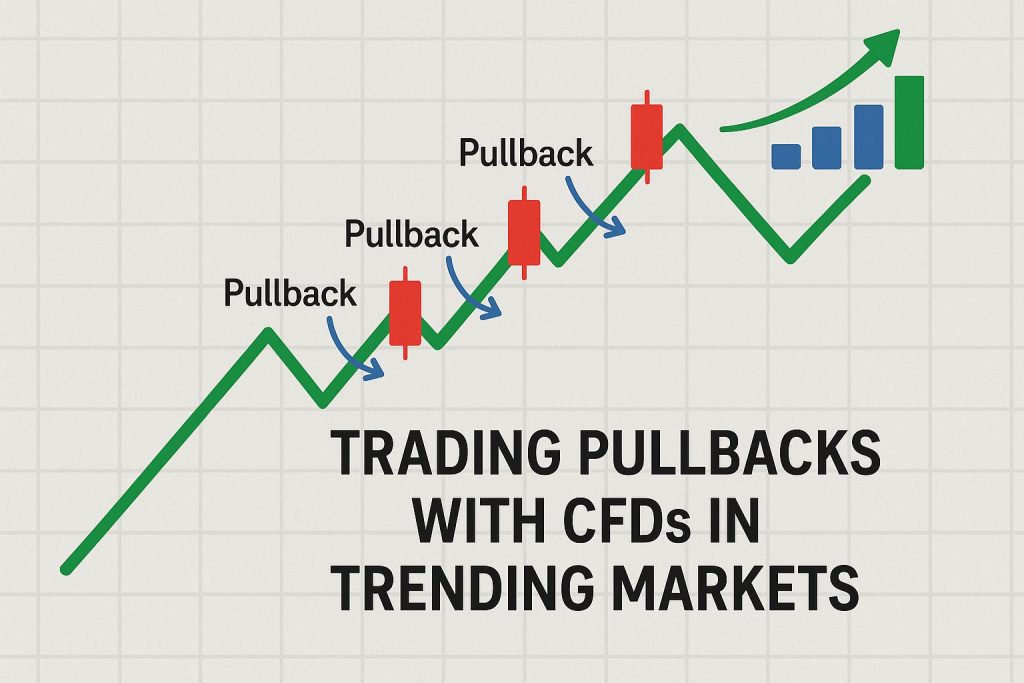
Understanding Pullbacks in Trending Markets
In the realm of trading, particularly in the dynamic environment of financial markets, pullbacks play a pivotal role. These are temporary reversals observed in the price of a financial asset, occurring within the overarching trajectory of an existing trend. For traders active in trending markets, pullbacks present a strategic opportunity to execute trades that align with the trend’s direction, but at prices that are potentially more advantageous. When it comes to Contracts for Difference (CFDs), having a solid grasp on the nuances of trading pullbacks can be immensely beneficial. It enables traders to capitalize on short-term price corrections without the necessity of owning the underlying assets.
Characteristics of Trending Markets
Trending markets are defined by their sustained price movements, which can either be in an upward or downward direction. Understanding these trends is fundamental to successful trading. In an uptrend, the market is characterized by a sequence of higher highs followed by higher lows, reflecting a bullish sentiment in the market. This indicates that buyers are in control, and the market is expected to continue rising. Conversely, a downtrend is marked by lower highs and lower lows, pointing to a bearish market sentiment. Here, sellers dominate, pushing prices lower over time. Identifying these trends accurately is crucial for traders aiming to employ pullback strategies successfully.
Identifying Pullbacks
Pullbacks can be identified by looking for short-term price movements that run counter to the direction of the primary trend. These movements are typically temporary and can result from factors such as profit-taking by traders, temporary shifts in market sentiment, or external news events impacting the market. A critical aspect of trading pullbacks is the ability to distinguish them from trend reversals. While a pullback represents a temporary correction against the prevailing trend, a trend reversal signals a potential change in the market’s direction. This distinction is vital for traders, as it influences their strategy and decision-making in the market.
Tools and Indicators
Technical analysis tools are indispensable for traders seeking to identify and trade pullbacks effectively. These tools offer insights that can aid in confirming whether a price movement is a pullback or something more significant. Some of the most commonly used tools in this regard include:
– Moving Averages: Moving averages smooth out price data to help identify the underlying trend direction over a given period. They can also indicate potential support or resistance levels where a pullback might pause or reverse.
– Fibonacci Retracement Levels: This technical tool is based on key levels derived from the Fibonacci sequence, which help traders predict potential areas of support and resistance where a pullback might end. Fibonacci levels guide traders in setting entry and exit points during a pullback.
– Trend Lines: Drawing trend lines on price charts is a basic yet effective method to visually identify the direction of the trend. These lines can also highlight potential areas where pullbacks could halt, signaling potential entry points for traders.
Trading Strategy for Pullbacks
Once a pullback has been identified and confirmed, traders must then formulate their strategy, involving a precise set of decisions regarding entry, stop loss, and take profit levels.
The entry point for a pullback trade is typically determined at the point where the prevailing trend resumes after the temporary correction. Traders enter the market at these levels to capture the continuation of the trend at a better price than before the pullback. When setting a stop loss, traders usually place it just beyond the recent swing high or low marked during the pullback to protect against potential larger losses if the market doesn’t move as anticipated. It acts as a safety net, ensuring that losses are minimized.
Take profit levels should align with the expectations of the trend’s continuation. However, these levels should be flexible and adjusted based on evolving market conditions to reflect realistic potential gains.
For traders eager to enhance their understanding and skills, numerous online resources and trading courses can provide deeper insights into technical analysis and strategies for trading pullbacks. Platforms like Investopedia are valuable resources, offering educational materials that help traders refine their strategies and approach within trending markets.
In conclusion, trading pullbacks within trending markets using CFDs presents traders with a unique opportunity to profit by leveraging careful analysis and strategic entry and exit points. By gaining an understanding of the dynamics that drive market trends and pairing this knowledge with the use of technical analysis tools, traders can improve their odds of capturing profits during temporary market corrections. The key to success lies in the ability to read the market accurately, apply appropriate tools effectively, and remain disciplined in executing strategies that align with the prevailing market trend.
This article was last updated on: June 26, 2026