
Understanding Mean Reversion Strategies in CFD Markets
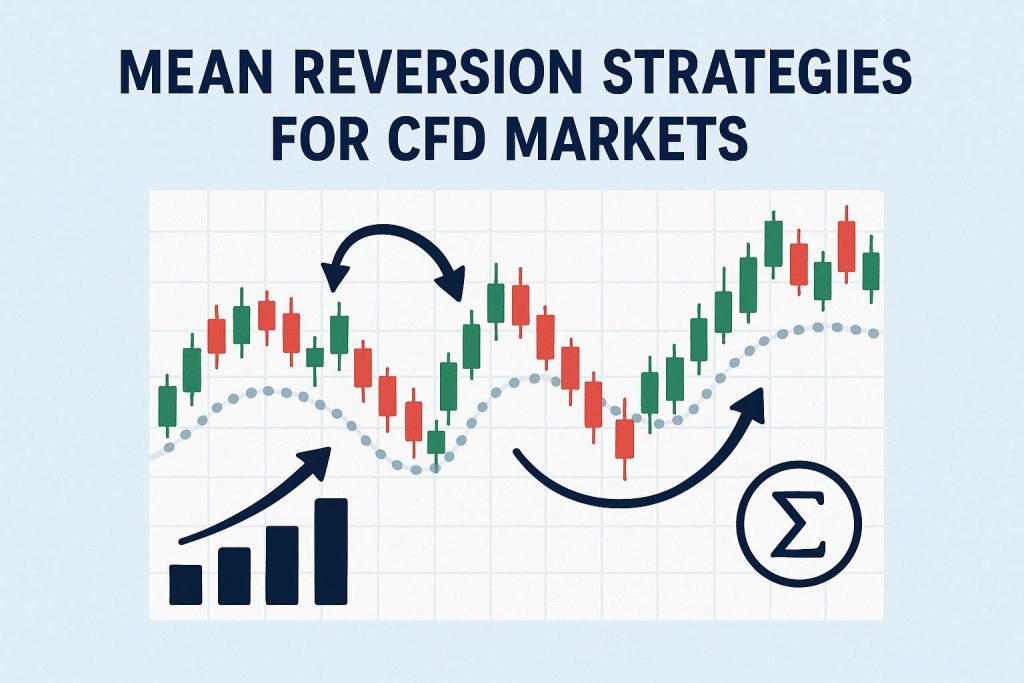
Mean reversion is a financial theory proposing that the prices of assets and their historical returns will eventually return to their long-term average levels. This concept is significant within the sphere of Contracts for Difference (CFD) trading, where mean reversion strategies are a key tool for traders. These strategies rest on the belief that prices oscillate around a mean value, and significant deviations from this mean are temporary. Consequently, when prices substantially diverge, it’s anticipated they will eventually revert.
The Concept of Mean Reversion
Mean reversion suggests a degree of stability in financial markets over time. This stability indicates that, despite short-term price movements, prices will ultimately return to a mean value. This theory serves as a foundation for traders who speculate on short-term price anomalies. A typical mean reversion strategy involves spotting the moments when an asset is either overbought or oversold and then taking a position that contradicts the ongoing trend.
Moreover, mean reversion can be viewed through several lenses. It is not just about stocks or commodities returning to a historical average. It reflects the broader idea of balance and equilibrium in markets, which dictates that extreme valuations—either too high or too low—tend to be temporary. Eventually, the market corrects itself, moving back towards efficiency and steadiness, which traders can capitalize on to secure returns.
Application in CFD Markets
CFD markets offer an ideal platform for utilizing mean reversion strategies. Through CFDs, traders can speculate on the price movements of a wide array of underlying assets, including stocks, indices, commodities, and currencies. These are derivative products that do not require ownership of the underlying asset, providing a flexible method for planning and implementing mean reversion strategies. The non-ownership aspect is particularly beneficial, as it allows strategies to be executed without substantial investment in the physical or actual financial instruments.
Traders can leverage CFDs to exploit price discrepancies more efficiently. For instance, in a scenario where a stock’s trading price has significantly deviated from its perceived intrinsic value, mean reversion strategies enable traders to take advantage of the anticipated correction. This is made feasible through the ability to engage in long or short positions based merely on market sentiment and predictions.
The Role of Indicators
Indicators serve as navigational tools within mean reversion strategies. They aid traders in pinpointing the right moments for entering or exiting positions, aligning with the forecasts of price reversion. Here are some commonly used indicators:
1. Moving Averages: These are vital for understanding the average price over a determined time frame. They smooth out fluctuations, allowing traders to identify trends and anomalies. In the context of mean reversion, traders are usually on the lookout for instances when the asset price diverges substantially from its moving average, signaling potential opportunities for reversion.
2. Bollinger Bands: Bollinger Bands create volatility bands around a simple moving average. They serve as dynamic thresholds that indicate potential overbought or oversold conditions. If an asset’s price breaches these bands, it might suggest an impending reversal, making Bollinger Bands an effective tool for mean reversion strategies.
3. Relative Strength Index (RSI): The RSI visualizes the speed and magnitude of recent price changes to evaluate overbought or oversold conditions. Typically, an RSI above 70 is a cue of an overbought status, while an RSI below 30 points to oversold conditions, both suggesting that a reversion to the median value may be plausible.
Challenges in Mean Reversion Trading
While potentially profitable, mean reversion trading carries certain risks and challenges. A primary challenge is an over-reliance on the historical price behavior’s persistence into the future. Substantial market shifts or groundbreaking news events can ignite prolonged trends or the establishment of new mean values, which can trigger unexpected losses if positions are poorly managed. As an added layer of complexity, mean reversion assumes past performance is indicative of future results—a hypothesis that may not always hold true.
Risk management is therefore crucial. Traders must develop and utilize robust stop-loss strategies to safeguard against scenarios where prices fail to return to the mean as anticipated. CFD trading often involves leveraging, which, although magnifying potential returns, also significantly heightens the possibility of considerable losses. Therefore, traders should approach mean reversion strategies with caution, ensuring that any leverage utilized is aligned with their overall risk tolerance and capital management objectives.
Conclusion
In conclusion, mean reversion strategies embody a valuable component of CFD trading, contingent upon thorough analysis and diligent risk management practices. By comprehending mean reversion principles and adeptly deploying technical indicators, traders can enhance their predictive capabilities regarding market movements and improve their trading outcomes. Nonetheless, it is imperative to remain aware of external market influences that could disrupt the expected mean value of the asset in focus. Continuous monitoring and adaptation to emerging market conditions are crucial for maintaining the effectiveness of mean reversion strategies and securing long-term success in the dynamic arena of CFD trading.
This article was last updated on: July 25, 2026