
TOC:
Swing trading on the CFD market means holding leveraged contracts for a few days to a few weeks to capture medium-sized moves, not tiny intraday noise and not multi month trends. You are trying to catch a meaningful chunk of a move on an index, forex pair, share, commodity or crypto contract, without staring at every tick from open to close.
The contract is a CFD, a deal with your broker where you exchange the price difference between entry and exit, instead of owning the underlying asset. That gives you access to many markets and the ability to trade long and short from one account. It also means you carry broker credit risk, financing charges and fairly high leverage in the background.
Swing trading sits in an awkward middle. Costs and fills matter like they do for day trading, because you might be in and out of several trades in a week. At the same time, overnight swaps, weekend gaps and news risk become a big part of your result. If you want to know more about how swing trading in general works, then I recommend visiting SwingTrading.com. There you can find guides on how to swing trade most different types of assets.
If you already know how CFDs function in theory, the question shifts from “what is a CFD” to “how do these rules behave when I hold trades for days instead of closing before bedtime”. That is where many CFD traders quietly bleed out, usually through financing, gaps or sloppy sizing rather than dramatic one-day disasters.
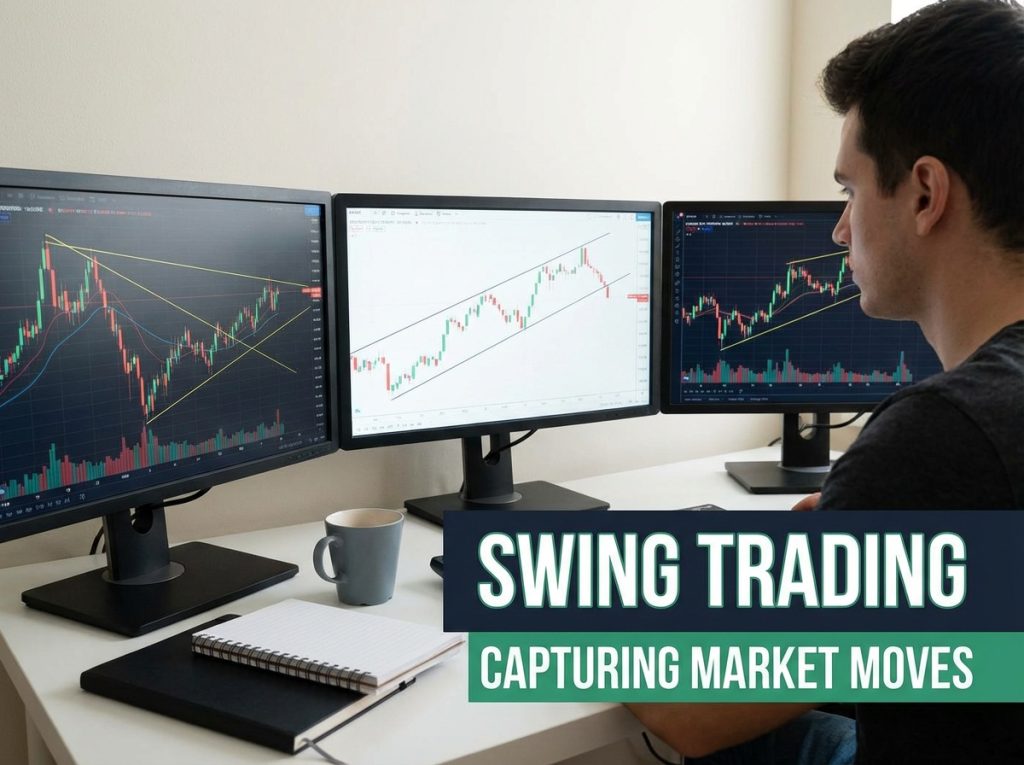
How CFDs work when you hold for days, not minutes
Underlying markets and what you’re really trading
A CFD mirrors the price of something else. That “something” might be an equity index future, a spot forex pair, a single share, a commodity future or a crypto instrument mapped to an external feed.
When you go long or short a CFD, you are not interacting with the exchange where the base asset trades. You are dealing with your broker. They may hedge your exposure on an exchange or with a liquidity provider, or they may warehouse risk internally. Either way, your profit and loss is booked against them.
For swing trading this matters in a few areas. First, you get access to markets that would otherwise need several different accounts, from global indices to metals and energy, often twenty four hours a day on the index side. That is convenient when you want to run a small roster of swing trades across asset classes.
Second, you are exposed to the quality of your broker’s pricing engine. Slippage on fast moves, behaviour around market open and close, and how they handle illiquid hours all feed into your swing trading result. A CFD on an index can trade when the cash market is closed; spreads might widen, gaps can appear, and your stops can trigger in a twilight period when the underlying is not trading.
Leverage, margin and why contract size matters
CFDs are leveraged. You post margin, and the broker lets you control a larger notional position. Regulation in many regions limits how far that can go for retail clients, but even a ten or twenty to one multiplier is plenty to damage an account.
For swing trades, margin is not just a mechanical requirement, it is a planning variable. You need enough free margin to absorb swings over several days without constant margin calls. If you size positions so that normal volatility pushes margin usage close to the limit, you are handing control to the broker’s liquidation engine, not your stops.
Contract size ties straight into this. One CFD on a major index might represent a certain currency value per point. Mini or micro contracts represent less. A swing trader who wants to risk, say, one percent of equity per trade needs to know that math cold. You adjust your number of contracts so that a stop placed at a logical chart level translates to a tolerable cash loss, not the other way round.
Intraday traders sometimes get away with hand-waving here because they can exit fast when a trade feels wrong. Swing traders usually hold through several full sessions, including overnight vents. If your sizing is sloppy, the market will find every weak point in your risk assumptions sooner or later.
Holding CFDs overnight: swaps, dividends and gaps
Financing charges and positive / negative carry
When you carry a CFD position overnight, your broker applies a financing adjustment. On forex and many index or commodity contracts, this appears as a swap or overnight fee. It reflects interest rate differences, funding costs on the broker side and a mark-up.
Over a single night the charge feels small. Over ten or twenty nights, it adds up. If your average swing trade lasts a week, financing becomes a regular friction. If you hold for several weeks, it can be a large share of your gross profit or loss on the price move itself.
Some positions earn carry. If the structure of rates and the broker’s settings work in your favour, you might receive adjustments for holding, rather than paying them. That is rare for many popular long exposures, and more common on certain short positions. You need to check the rate per instrument, per direction, rather than assume.
Swing traders who ignore swaps often discover that a “pretty decent” strategy on paper turns into a grind around break even once the daily financing line is included. It is boring analysis, but if you trade CFDs on multi day horizons you really want to plug realistic swap numbers into your backtesting or rough forward projections.
Corporate actions, rollovers and weekend risk
Share and index CFDs also reflect corporate actions. If you hold a long index CFD through an ex-dividend date on its component shares, the broker usually credits a dividend adjustment to your account. If you are short, they debit it. For single share CFDs the adjustment tends to mirror the real dividend flow more closely.
For swing traders on equities this can soften the effect of holding a portfolio versus a pure technical approach. It can also surprise you if you are short several high dividend names during a busy season. Dividends do not show up as huge spikes on charts, but they move cash in and out of your trading balance.
Futures-based CFDs roll from one underlying contract to the next. Brokers handle that roll with varying methods. Some adjust prices with a synthetic gap, others adjust contract specifications while keeping the screen series continuous. Swing traders holding a position across roll dates need to know how that looks on their particular platform, or they will think the market gapped them when it was just a technical adjustment.
Then there are gaps from real news. Weekend risk is very real for indices, FX and commodities. A political shock, a surprise central bank move or a sharp change in risk sentiment can mean your Monday open is far from your Friday close. On CFDs, pre-market and out-of-hours pricing can show those moves before the cash session, and stops can trigger inside that grey zone.
Swing trading accepts that kind of gap risk as the price of not living like a day trading robot. That means you plan with it in mind. You size so that even a nasty gap against you hurts but does not wipe you, and you avoid obvious no-win holds, such as carrying heavy size through major binary events without a very good reason.
Choosing markets and timeframes for CFD swing trading
CFD menus look generous. You can swing trade stock indices, forex pairs, precious metals, energy contracts, agricultural commodities, single shares and a variety of crypto tickers from one login. That does not mean you should touch everything.
Indices suit many swing traders. They represent baskets of stocks, so idiosyncratic single-name risk is lower, and they respond well to macro and sentiment drivers. Overnight moves are still sharp sometimes, but one company’s earnings miss is less likely to blow up your position.
Forex CFDs give you access to currency swings driven by interest rate expectations, macro data and risk trends. Volatility per day is often lower than in equity index land, which lets you place tighter stops in pip terms. On the other hand, swaps on some pairs can be heavy, and trends can grind for long periods before turning.
Commodity CFDs can be more erratic. Oil, gas and some metals react heavily to macro headlines and supply disruptions. Swing traders in these markets usually accept higher volatility and structure trades with wider stops and smaller size.
Single share CFDs add company specific news. If your swing style leans into earnings momentum or post-news drift, share CFDs give you an easy way to express that, long and short, sometimes with small contract sizes. They also bring more corporate events and higher gap risk.
Crypto CFDs sit at the spicy end. Volatility can be large even over a single day, and weekend sessions are fully live. Swaps and funding rates on leveraged crypto exposures can be painful if you sit on the wrong side through strong phases. For new swing traders they are usually better as a small experiment, not a main line.
Timeframe stacks and how long a “swing” actually lasts
Swing trading does not have a fixed holding period. Some trades last two days, some three weeks. What matters is that you use timeframes that match the sort of move you want to capture.
Many CFD swing traders use a higher timeframe, such as the daily chart, to define bias and structure, then drop to four-hour or one-hour charts to fine-tune entries. The daily shows you trend, major support and resistance and how price reacts around them. The lower timeframe lets you time entries when a pullback looks near completion or when a breakout retests level.
You then accept that a trade may need several bars on the daily chart to play out. That automatically means holding through several overnights. Intraday noise on lower charts is background; you care much more about where the daily closes and whether the structure that justified your entry is still intact.
Shorter timeframes can still support swing logic, but if you make decisions off fifteen-minute candles, you are likely sliding toward day trading, just with less frequent exits. The stress level starts to look like day trading too, because every micro move feels important.
Building a swing approach on CFDs
Framing bias with higher timeframes
A basic swing process starts with direction. You want a clear sense of whether you are looking for longs, shorts or both on a given market. The daily chart tends to be the simplest place to do that.
You look at trend: series of higher highs and higher lows, or the opposite. You watch how price reacts at prior swing highs and lows, round numbers, moving averages if you like them, and any obvious trend lines or channels. You note where large impulsive moves started and whether pullbacks are shallow or deep.
From that you decide whether the market is trending or range bound, and where the “value area” for new trades might sit. In a trend, that might be pullbacks toward a moving average band or prior breakout level. In ranges, that might be near the edges, with mean reversion trades back inside.
CFDs let you apply that same process across several markets quickly. The danger is overdoing it, filling your screen with twenty charts and taking every semi-decent opportunity. Swing trading still benefits from focus. A handful of well understood markets, traded repeatedly, usually beats a scattergun approach across the whole product list.
Entries, exits and trade structure
Once you have bias, you define how trades actually start and end.
Entry rules can be simple. In an uptrend, you might buy when price pulls back into a certain zone and then prints a sign of strength: a strong close off the lows, a small consolidation that breaks higher, or a clear rejection wick. In a range, you might short near resistance when momentum rolls over, or buy near support after a fake break.
Exits come in two flavours. You decide where you are proven wrong, and where you will take profits if the move behaves. Wrong might be a break and daily close beyond a certain level, which you translate into a stop loss level plus a small buffer for CFD spread and noise. Profit could be at recent swing highs or lows, a measured move projection, or a reward to risk multiple you are comfortable with.
CFDs give you tools such as stop and limit orders, trailing stops and sometimes partial close features. You can construct a trade where part of the position comes off at the first target and the rest runs with a moved stop. Used sensibly, that can smooth PnL. Used as a way to avoid hard decisions, it just creates random behaviour.
The important part is that you write rules that you can follow during quiet days as well as during wild ones. Swing trading hurts when you close trades too early because nothing much happened for two sessions and you got bored, only to watch price move as planned on day three.
Position sizing and scaling tactics
CFD position size is where many swing traders quietly blow up. The product makes it easy to open a position that is far too large relative to your account because the margin requirement looks small.
A cleaner method is to decide how much of your account you are willing to risk if a trade hits its stop, then back out position size from that. If you risk one percent per trade, and your stop is fifty points away, and each CFD pays one currency unit per point, you can calculate the number of contracts that equals that loss at the stop level. The formula is simple, but you have to actually use it.
Scaling adds another layer. Some swing traders add to winners when price moves in their favour and structure remains valid. That can grow exposure in strong trends, but it needs strict rules; you only add if volatility stays under control, and you move stops up to keep total risk contained. Adding to losers, in contrast, is usually just a slow version of blowing up, especially in leveraged CFDs.
Portfolio level exposure matters too. You might risk one percent per trade, but if you have five trades on that are all long equity indices, you are effectively betting five percent on the same macro theme. Correlation does not care about the fact you picked different ticker symbols from the broker menu.
Risk management across days and weeks
Per-trade risk, portfolio heat and correlation
Per-trade risk is the first dial. Many swing traders stay in the one to two percent per trade zone, often lower once account equity grows. That gives you enough impact when trades work, while leaving room for a string of losses without emotional meltdown.
Portfolio heat is the total risk across open trades if every stop were hit. If you have five trades each at one percent risk, your portfolio heat is five percent. That might be fine for a robust trader in calm conditions, and too much for someone still building habits. You can set a hard cap on heat, such as three or four percent, and refuse new trades if that would be exceeded.
Correlation awareness keeps you honest. If you are long S&P 500, long DAX, long a tech share CFD and long crude oil, your heat is more concentrated than it looks in a simple table. Macro shocks will hit most of those in the same direction. One way to manage it is to label trades by theme, such as “equity risk on”, “dollar strength” or “safe haven bid”, and then avoid loading more than a stated amount into one theme at the same time.
Dealing with news, gaps and black swans
News is part of swing trading. You will hold through economic releases, earnings dates and unexpected headlines. Completely avoiding all events is not realistic if you want to catch medium moves.
What you can do is have a policy. You might decide never to open fresh swing trades just before major scheduled news, and to halve size or tighten stops on existing ones if you feel overexposed. You might decide that certain binary events, such as central bank rate decisions, elections or major legal rulings, are not worth holding through at all unless your trade is already very far in profit.
Black swan events – sudden shocks outside the expected calendar – cannot be planned in detail. You deal with them in aggregate via modest leverage, conservative position sizing, and avoiding brokers with a history of aggressive re-pricing during stress. A single ugly gap can still hurt, but it is less likely to empty the account in one shot.
CFD swing traders sometimes forget that “do nothing” is a valid protective move. If volatility spikes and your setups do not fit the new regime, staying in cash for a few days is as much a decision as entering a trade.
Psychology of CFD swing trading
Boredom, over-trading and PnL fixation
Swing trading sounds calmer than day trading, but it comes with sneaky psychological problems. Boredom is the big one. You plan a trade, enter it, and then not much happens for a few days. Price drifts near your entry, maybe slightly against you. The temptation is to meddle: close early, flip direction, or add random new trades just to feel active.
That behaviour usually wrecks the edge you had on the original setup. Many swing traders who think they have bad systems really have bad patience. They never give trades enough room and time to work.
PnL fixation is another trap. Because swing trades are larger and last longer than scalps, you might watch floating profit or loss too often and let it dictate mood. Checking the account every ten minutes when your trade is based on daily candles makes no sense, yet it becomes a habit. It also makes it harder to follow rules when a trade gets close to a stop or target.
One antidote is to define check-in times. You might review charts once or twice per day, update stops if needed, and then log out. Alerts on price levels help: you can step away and let the platform notify you when something important happens instead of babysitting every tick.
Over time, the real test of your swing trading psychology is not how you behave on big winning days, but how you behave in flat stretches where nothing much pays out and everything feels slightly annoying. That is where traders start overriding rules, chasing extra trades and slipping back toward random behaviour.
Practical workflow: from idea to execution and review
Scanning, planning and logging
A practical CFD swing trading routine usually follows a simple loop. You scan for setups, plan trades, execute according to rules, then review.
Scanning can be as basic or as fancy as you like, as long as it finds charts that fit your approach. That might be as simple as manually flipping through a watchlist of indices, a dozen forex pairs and a handful of commodities and shares, marking where trend and structure interest you. Or it might involve screening tools that filter for volatility, trend strength or price patterns.
Planning happens before the trading session. You mark potential levels, note upcoming news, and decide in advance what would trigger a trade. That way, when price approaches your zone, you already know what you will do instead of improvising under pressure.
Execution should be almost boring if the prep was good. You place orders, set stops and targets, and avoid tinkering unless the market invalidates your premise. If you find yourself constantly moving stops closer just to “protect” small floating gains, something in your plan or confidence needs attention.
Logging closes the loop. After trades close, you write down entry, exit, context, reasons and emotions. Over a few months that journal tells you more about your real swing trading behaviour than any theory. You will see patterns such as “I always trade too big on Mondays” or “my trades taken right after a prior loss perform badly”.
Swing trading on the CFD market is less about finding the perfect pattern and more about getting dozens of small, boring decisions roughly right, day after day. The product gives you flexibility across many markets. The cost is that leverage and financing sit quietly behind every chart. If you respect that, and keep your process simple and repeatable, CFDs can support a controlled swing approach instead of turning every week into a new drama.
This article was last updated on: February 25, 2026