
TOC:
CFDs and binary options often sit on the same broker site, share the same charts and offer exposure to the same instruments. EURUSD on a CFD ticket does not look that different from EURUSD on a binary ticket. Under the hood they are completely different contracts.
One is a margin product that mirrors the price of an underlying asset, tick by tick. Your profit and loss rise and fall with each point of movement until you close. The other is a fixed bet: if a condition is true at a set time you get a preset payout, if not your stake is gone.
For a trader with basic experience this difference is not just theory. It shapes how risk builds up in your account, how you use stops or hedges, and how realistic it is to have any positive expectancy over time. There is a reason regulators across a lot of regions have squeezed retail binaries hard, while CFDs, for all their risks, still sit inside the mainstream derivatives box.
This piece walks through what each product actually does, how the payoff maths work, and why, for a trader who takes their capital even half seriously, a CFD is usually a much saner choice than a binary ticket dressed up as “simple trading”.
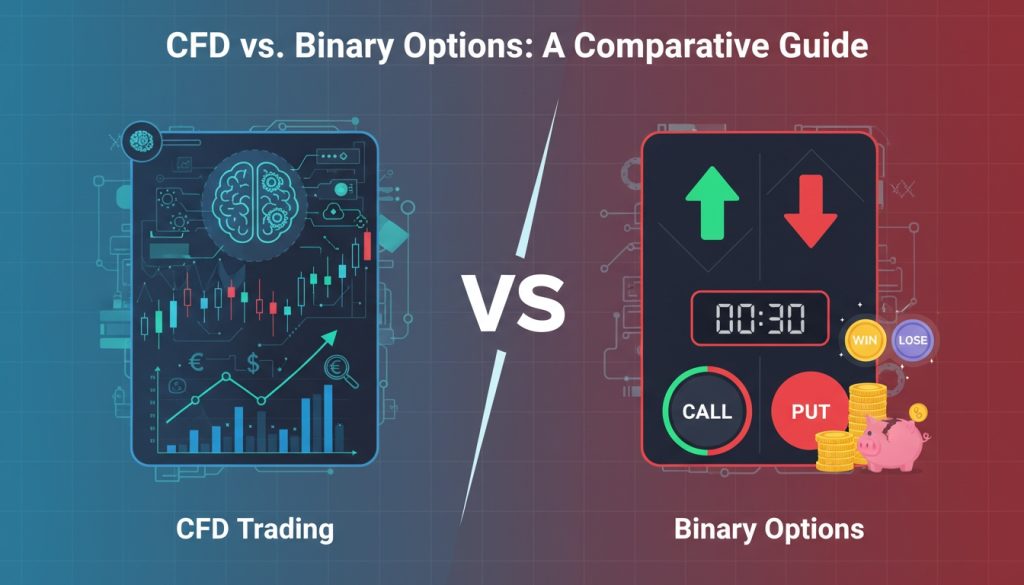
What a CFD actually is in practise
A contract for difference is a simple idea wrapped in some jargon. You and a broker agree to exchange the difference between the opening and closing price of an asset. You never own the asset itself, you just settle the change in price.
You open a CFD long on an index, for example. If the index rises fifty points, your position shows a profit of fifty points multiplied by your stake per point. If it falls fifty points, same maths in reverse. You can close any time the market is open by hitting the close button, placing an opposite order or running a stop. Your realised result is the net of all those price changes, minus spreads, commissions and overnight financing.
Because CFDs are margin products, you only need to post a fraction of the notional value as collateral. That can help capital efficiency for hedging or short-term trading, but it also means price swings translate into large percentage moves in account equity. Brokers set margin rates, stop-out rules and overnight financing charges, and those details matter a lot in practise.
The important part is that a CFD payoff is linear. If the underlying moves twice as far in your favour, you roughly make twice as much, ignoring costs. If you are wrong but cut the trade early, you take a smaller loss than if you sit through the whole move. You can scale your stake, move stops, partial close, hedge with other CFDs or underlying positions. The contract is just a mirror of price changes.
On the institutional side, the same idea shows up in swaps, forwards and other derivatives. Retail CFDs are the friendly front end on that machinery. That does not make them safe by default, but it does mean they fit into a known risk framework and can be used for more than just directional punts.
What a binary option is and why regulators dislike it
A binary option, in its common retail form, is much more blunt. You pick a direction and a time. The market either finishes above or below a strike, inside or outside a range, or meets some other condition at expiry. If you are right you receive a fixed payout. If you are wrong you lose your stake.
Say a platform offers you an hourly binary: “EURUSD above 1.0900 at 15:00”. You put down 100 units of account currency. The screen says you will receive 180 if you are right. At 15:00 the reference price is checked. If it is above the strike, you get your 180, stake included. If it is at or below, you get zero. The path did not matter. The contract does not care that you were twenty pips in profit for most of the hour and it flipped in the last minute.
Under the surface this payoff is a kind of digital option, a standard exotic option used in institutional books. On the retail side, though, the way many binary platforms have structured odds and handled client money has turned them into something closer to a casino product.
The broker often sets the payout rates such that, even with fair random outcomes, the average customer should lose money. Combine that with aggressive marketing, short expiries and the illusion of control from watching a chart, and you get behaviour regulators really do not like. Many watchdogs now warn that most binary traders lose their capital quickly and treat retail binaries as gambling rather than investment products.
The other long history of trouble has been on the conduct side. Mis-priced feeds, sudden platform outages near expiry, withdrawal issues and opaque terms have all been common complaints. Moving the same payoff structure on-chain through DeFi contracts does not change the basic shape: fixed payout, fixed loss, short time frame, strong temptation to overtrade.
You can read a more in-depth overview of binary options by visiting BinaryOptions.net. Website completely devoted to binary options.
Payoff structure and risk profile: linear vs all-or-nothing
Once you strip away branding, the core difference between CFDs and binaries sits in the payoff shape. A CFD is a straight line. A binary is a step.
With a CFD long, your P&L moves point by point with the underlying. If you buy an index CFD and it moves ten points in your favour, you are up ten stake-units. If you do not like the look of the order book any more, you can close for that modest profit, or take a small controlled loss if price moved against you. Your exit time is your choice.
With a binary call on the same index, your P&L is either the fixed payout or zero. Being “a bit right” does not matter. Closing early, on platforms that allow it, usually means selling the contract back at a price that reflects the current probability of finishing in the money. That price embeds the house edge and can move against you very quickly near expiry.
This is more than academic shape talk. It changes how risk accumulates over a sequence of trades. With CFDs, if you are disciplined about cutting losers fast and letting winners run within reason, your distribution of trade outcomes can have small average losses and occasional larger wins. You at least have room to build a positive expectancy if your read of the market is decent and your cost base is not too heavy.
With binaries, each trade is a coin flip with skewed odds. You lose one unit when wrong and gain less than one unit when right, because of the payout haircut. Even if your directional call is better than random, the built-in negative edge means you need to be very right very often just to stand still. No tweak to stop placement can fix that, because the payoff is locked.
Risk of ruin behaves differently too. CFD accounts blow up when position sizing is too large relative to capital and margin, or when stops are ignored. There is still at least some scope to slow down or flatten exposure. Binary accounts tend to blow when traders start stacking short-dated bets to “win it back”, since each new position commits a full chunk of stake to a yes/no outcome with no partial loss option.
That all-or-nothing profile is emotionally attractive. It feels clean. You know exactly what you can lose. You also know that the broker’s maths quietly expect you to lose it if you repeat the bet often enough. With CFDs, the contract does not secretly bend your odds; the danger comes from how you size and manage trades.
Pricing, costs and expected value: house edge vs trading edge
Underneath the UI, both CFDs and binaries have a cost structure. The question is whether that structure gives you at least a shot at breakeven over time if you trade well, or whether the product is designed so that the average client bankroll will drain even with decent calls.
CFDs charge through spreads, commissions and overnight financing on positions held across sessions. If you trade the most liquid instruments, spreads can be tight, and commission schedules are fairly transparent on better brokers. Overnight financing can bite if you hold geared positions for many days, but for intraday or swing trading over a short horizon, the drag is usually manageable relative to potential move size.
In other words, if your trading method can find trades where expected move more than covers spread, commission and any overnight cost you accept, the contract itself is not unhelpful. You still have to do the work to reach positive expectancy, but the broker is not tilting the basic payoff against you beyond those explicit charges.
Binary options platforms, on the other hand, build their edge into the payout rate. If a contract has a true fifty-fifty chance of finishing in the money and the platform pays you eighty on a hundred stake when you are right, then even a perfect coin toss trader will end up losing. On every two bets, the expected gain is 0.5 × 80 minus 0.5 × 100, which is negative. Stretch that across a hundred or a thousand bets and the expected result is a loss, even with no behavioural mistakes.
Some platforms adjust payouts dynamically based on order flow so that, in theory, odds reflect the current market view. The cut is still there. It has to be, or the house would not make money. Unlike a bookmaker in sports betting who sometimes misprices lines, binary houses tend to run very tight models because the underlying is usually a liquid financial asset.
CFD brokers can and do earn healthy revenue from spreads, commissions and financing, especially from clients who overtrade or hold geared positions for too long. The difference is that their income is not locked into the same hard negative expectancy per trade. A skilled client can be profitable over time, and the broker still earns from volume. With binaries, the platform’s revenue depends directly on the gap between fair odds and offered payouts.
Most traders are not going to sit down and calculate expected values before every trade. So a simple rule of thumb helps: if the pricing structure is opaque and the product pays you less than one when you risk one on what looks like a roughly fifty-fifty event, you are playing against a loaded table.
Trade management flexibility: entries, exits, hedging and mistakes
Any trader with a few months of screen time knows that the first entry is rarely perfect. Conditions change, news hits, order flow looks different five minutes later. Product structure decides how forgiving that reality is.
In a CFD account, you can scale in, scale out, flip direction or flatten completely whenever the market is open. Enter long too early on a stock index, see sellers step in stronger than expected, you can cut for a small scratch or partial loss and reassess. On a strong trend, you can lock partial profits and let a runner ride with a tightened stop. You can hedge exposure by taking offsetting positions in related instruments.
Mistakes cost money, but the platform at least gives you tools to handle them. You are free to be flexible as your read changes. That freedom can be abused, obviously, but it is there.
Binary options are much sharper edged. You decide on a direction, stake and expiry. Once the trade is on, your main action is to sit and watch. Some platforms allow early sale of contracts back to the house, at a price that reflects current probability. In practise that tends to be a bad deal near expiry when decay is severe. Scaling in is basically just opening another separate bet, with no netting.
There is also no way to express nuance. Suppose you think EURUSD will drift up today but might spike down around a data release. With CFDs you can trade smaller before the event, cut risk ahead of the print, then add after if your view is confirmed. With binaries you either bet on the outcome at a particular time or you stay flat; the clock decides, not your reading of intraday structure.
Hedging is similarly awkward. Institutional desks use simple options, futures and spot to build hedges that respond gradually to price movement. Binary contracts flip from zero to one at a point; they do not make good building blocks for smooth protection profiles in a normal portfolio.
That does not make CFDs easy, far from it. It does mean that product design is not fighting you when you try to manage risk mid-trade. The structure lets you change your mind, correct errors and apply position management rules in a way that is nearly impossible with a binary ticket.
Broker models, regulation and counterparty risk
Both CFDs and binary options are usually offered by brokers or platforms acting as your counterparty. The way that role is supervised and funded matters a lot once real money is on the line.
CFD brokers in major regions generally hold licences under financial regulators. Those licences impose rules on capital, handling of client money, reporting and marketing. The bar is not perfect and there are weak spots, but there is at least a framework. Larger CFD providers also hedge client flow through futures, swaps or direct market access, which ties them into the same clearing and banking systems used by other financial firms.
Binary options platforms have built a much rougher track record. Many have operated from looser jurisdictions, with little or no oversight, aggressive sales practices and very light disclosure. There are regulated binary markets on big exchanges, but retail traders usually do not see those. They see offshore sites with strong bonuses and weak supervision.
This shows up fast when something goes wrong. A dispute about slippage or platform outages on a regulated CFD platform can go through an internal complaint process and then, if needed, to an ombudsman or regulator. A dispute on an unregulated binary site usually ends in canned support emails and a reminder that “management decisions are final”.
On the product side, CFDs are recognised derivatives. Banks, funds and corporates use the same economic structures, just with different wrappers. Regulators may restrict margin or marketing, but they rarely call the product itself a scam. Binary options, by contrast, have been explicitly compared to fixed-odds bets by many authorities. In some areas retail sale has been banned or choked down to near zero.
Counterparty risk is still real with CFDs. A broker with weak risk controls can fail in a stress event. Client money protections are not absolute. But comparing a reasonably well capitalised margin broker to a thinly capitalised binary site is not a close contest from a safety angle. The typical CFD setup at least tries to live inside a regulated financial system. Many binary shops exist outside it as long as they can.
Matching product to use case: why CFDs usually make more sense
Once you strip away headlines and horror stories, the question is simple. What are you trying to do, and which product lines up with that aim.
If your aim is to speculate frequently on very short-term moves with fixed stakes, more as entertainment than as a serious trading business, then binaries are a blunt but honest fit. You know from the start that the odds are tilted, that you are in an all-or-nothing game, and that the most likely end state for the account is zero after enough spins of the wheel.
For almost anything else a trader with a basic plan might want to do, CFDs line up better.
Directional trading across time frames works more cleanly with a linear product. You can hold positions through multi-day swings or scalp shorter moves, scale size to fit volatility, and use stops that relate to actual market structure instead of arbitrary expiry times. If you run a strategy with a real statistical edge, CFDs at least give that edge room to breathe.
Hedging is more natural through CFDs. A stock investor can short an index CFD during periods of uncertainty to cut net exposure. A corporate treasurer can use FX CFDs as a rough overlay on smaller exposures. These are not perfect hedges, but they use the same price path and settlement style as the risk they are offsetting. Binary payouts do not map well to that kind of use.
Capital growth over the long run depends on compounding. That means controlling drawdowns and keeping losses, on average, smaller than wins. CFD accounts can be structured to support that, with sensible margin, position sizing and stop rules. Binary contracts, with their constant full-stake loss on each wrong bet, produce very lumpy equity curves that are hard to smooth without simply trading less often.
Even from a psychological angle, CFDs tend to encourage slightly more process thinking once a trader gets past the early “all in on this candle” phase. You have to think about risk per trade, exposure across pairs, correlation. With binaries, it is easy to drift into almost pure gambling behaviour because the contract invites it.
This article was last updated on: February 17, 2026